
In a competitive market, with pressure on costs and selling prices, predictable production becomes essential. At Beavers, we see irrigation as a strategic priority wherever technical and economic potential exists. For some farms, access to water can even affect their ability to continue operating after difficult growing seasons.
A carefully chosen irrigated area can support higher yields, reduce vulnerability to drought and create opportunities for more productive cropping systems. However, the result depends on a system that works from the water source to the plant, and on an investment suited to the farm’s economics.
No million-euro combine can recover a crop lost through lack of water.
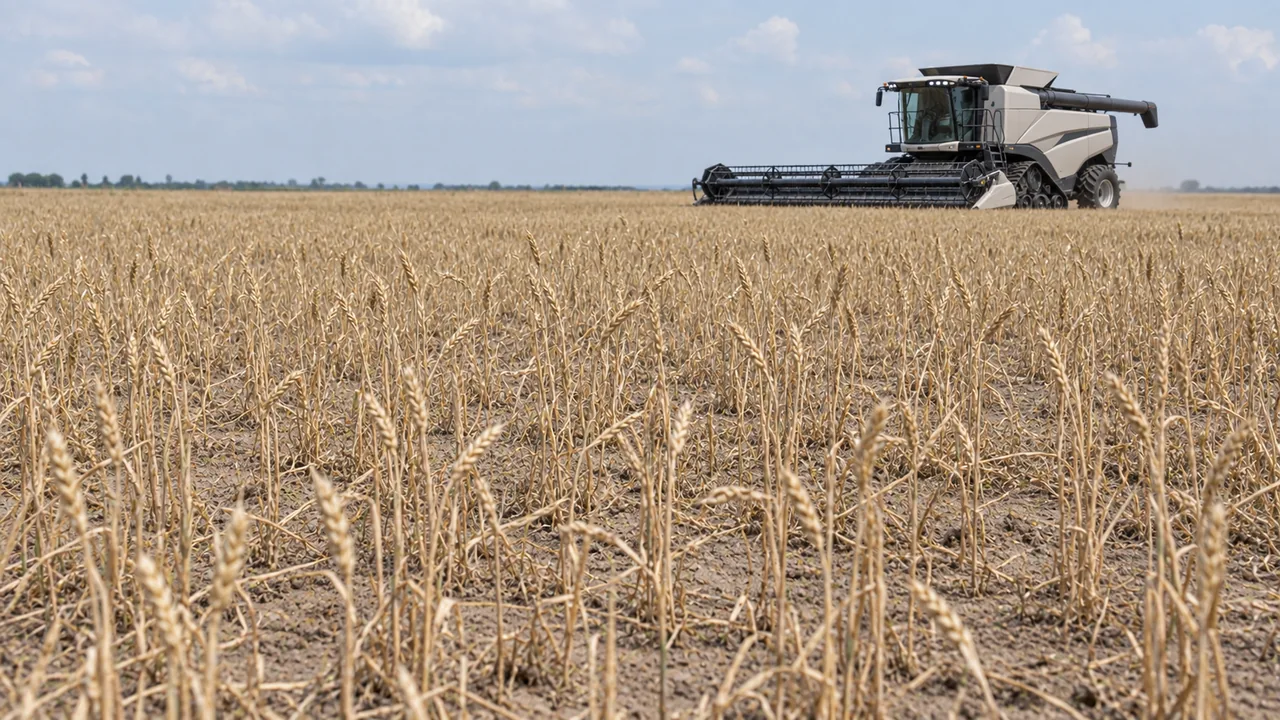
High-performance machinery has its role. Investment priorities must nevertheless reflect the factor that limits production on the farm. When that factor is water, it is worth understanding first how to secure it.
In Beavers’ experience, the earliest decisions shape much of a project’s future: which source is available, how much water can be used, which area can be served and at what cost. These questions deserve answers before equipment is ordered.
If lack of water limits your production, it is worth finding out what you can actually do on your farm. The first step can be an assessment, before committing to the investment. That is precisely where HydroAudit begins.
In this article
- 1. Assess the water source and demand together
- 2. Water demand: what the FAO methodology tells us
- 3. Water conveyance can determine the economics of the entire system
- 4. The reservoir, pumping station and energy supply form one project
- 5. Higher yields and more options for the farm
- 6. Irrigating 300 ha can provide a stable core within a 1,000 ha farm
- 7. ROI and payback: from production to available cash
- 8. The investment can be developed in 3–4 phases
- 9. Include permitting in the investment schedule
- Start with HydroAudit. Find out what is possible before deciding how much to invest.
1. Assess the water source and demand together
Identifying the source is the first step. A nearby river, canal or borehole is a starting point. What matters for the project is the flow available at peak demand, continuity of supply, water quality and the conditions under which it may be used.
The source must also be assessed during dry periods, when crop demand may be high. Its capacity must match the area, crops, soil, farming calendar and operating arrangements. Seasonal volume and the flow required on a peak day are different figures; both influence the solution.
Through HydroAudit, Beavers assesses the farm’s circumstances and matches the source with demand and feasible infrastructure. The aim is to identify a suitable technical and economic option before the client commits to investments that are difficult to change.
From source to crop
- 01Water sourceFlow, continuity, quality
- 02ConveyanceRoute and conveyance cost
- 03Storage, if requiredUsable volume and supply
- 04Pumping and energyFlow, pressure, consumption
- 05DistributionNetwork and equipment
- 06CropIrrigation matched to demand
2. Water demand: what the FAO methodology tells us
The FAO 56 methodology provides a framework for estimating crop water use. Under the single-coefficient approach, crop evapotranspiration under standard conditions is expressed as ETc = Kc × ETo: ETo reflects atmospheric evaporative demand, while Kc varies with crop type and growth stage. There is no single FAO water allowance that applies identically to every farm.
Irrigation input is determined using the water balance: crop consumption, effective rainfall and water available in the root zone. Net crop requirements are then converted into supply volume, allowing for conveyance and application efficiency.
The irrigation depth per application expresses the quantity applied in one irrigation event; the seasonal irrigation requirement totals the irrigation supplied over the season. Design also depends on the interval between applications, available operating hours and the ability to cover peak periods. Scheduling must be adjusted to soil moisture, weather and crop growth stage.
From hectares and millimetres to flow rate
300 × 6 × 10
18,000 ÷ 0.80
22,500 ÷ 20 hours
The example shows why hectares alone are insufficient for selecting pumps. Assumptions must be replaced with farm data. A reservoir can separate supply and demand in time, but cannot offset a permanent shortfall at the source.
3. Water conveyance can determine the economics of the entire system
Once the source is identified, we assess the route to the fields. We compare buried pipelines, open channels or combinations, depending on existing infrastructure and site conditions. A useful assessment includes initial investment, water losses, maintenance, land access and operating energy.
In a pressurised system, route length, pipe diameters, elevation differences and equipment pressure requirements must be coordinated. Saving on pipe diameter may mean higher head losses and pumping costs. For open channels, we assess seepage, evaporation, sedimentation and maintenance, among other factors. Options are compared over their service life, not just by price per metre.
4. The reservoir, pumping station and energy supply form one project
Supporting infrastructure may include storage reservoirs, intakes, pumping stations, filtration, power supply, automation and distribution networks. Each component contributes to the operation of the whole system.
A reservoir is assessed by its usable volume and filling and emptying pattern. Pumps are selected for the flow and head required under actual operating conditions. Power supply must be checked early, including connection cost and available capacity. Pivots, drip systems and other equipment must be chosen in line with these conditions.
We have encountered situations where equipment was ordered before the water source or infrastructure cost had been clarified. There have also been farms with irrigation potential that postponed investment because they lacked a clear picture of the steps and budget. An early assessment can change both situations.
5. Higher yields and more options for the farm
Well-timed irrigation can limit losses caused by water deficit and help make better use of farming technology. Timing and soil water availability matter; excessive irrigation adds costs and can increase nutrient losses.
For maize, timely water availability allows farmers to consider high-potential hybrids suited to intensive production and irrigated conditions. Selection must reflect maturity, plant density, fertilisation and local trial results. Outstanding yields demonstrate the potential of combining genetics and management successfully; farm budgets, however, should rely on repeatable, evidence-based yields.
Irrigation can also support a double-cropping strategy, for example barley followed by soybean. Feasibility depends on an early enough harvest, the sowing window, variety, available water and time remaining to maturity. The second crop also brings additional costs that must be included in the economic assessment.
A more predictable forage supply for livestock
Irrigation can be important to a livestock farm even with limited land. A simple system suited to the fields and an accessible source can support forage crops and reduce dependence on purchased feed in dry years.
Under favourable conditions, the solution may require less investment than extensive infrastructure for large areas. We assess the herd’s feed needs, achievable production on available land, water costs and operating effort. The aim is a real contribution to the farm’s forage supply. Coverage is established through a balance, without assuming that a small area can automatically meet every animal’s needs.
6. Irrigating 300 ha can provide a stable core within a 1,000 ha farm
A farm can benefit from irrigation even when its source, terrain or budget prevents coverage of the entire area. On a 1,000 ha farm, a well-managed irrigated core of 300 ha can contribute to more predictable income and better planning.
A 1,000 ha farm with an irrigated core
30% of the area
70% of the area
That contribution must be calculated for the whole farm: the margin from the irrigated area, operating and financing costs, and how the other 700 ha perform in a difficult year. The 300 ha may reduce exposure to drought, but do not eliminate risks relating to the source, energy, prices or the rest of the farm. Irrigating 30% of the area does not automatically secure 30% of income.
7. ROI and payback: from production to available cash
Additional production has economic value when the resulting income covers added costs and helps recover the investment. The assessment starts by comparing the same farm with and without the project, using the same price assumptions and comparable growing seasons.
We consider the complete investment — source, conveyance, reservoirs, pumps, electricity, equipment, design and permits — and recurring costs: energy, water, labour, maintenance, extra inputs, harvesting and, where needed, drying. We distinguish accounting profit from cash available for payments.
Production must translate into cash flow
ROI expresses the return relative to invested capital and must specify the period and calculation method. The payback period shows how long it takes for additional cash flows to cover the investment. The simplified formula in the diagram assumes constant annual cash flows; where they vary, their accumulation is tracked year by year. A full assessment may also use net present value and internal rate of return.
A properly sized project with a reliable source and controlled operating costs can offer an attractive payback. Its speed is assessed through conservative, baseline and favourable scenarios. We test the effects of lower crop prices, higher energy costs, yields below expectations or limited water availability. For bank financing, repayment schedules and cash remaining in the farm are checked separately; the outcome cannot be inferred from yield per hectare alone.
8. The investment can be developed in 3–4 phases
In our experience, a pilot project can start a larger development. We have worked on investments that were extended later and proposed implementation over several rounds, with a plan established from the outset.
One shared plan. Investment in phases.
- 01Assessment and planSource, demand, budget, permits.
- 02Initial areaPilot or functioning core.
- 03ExpansionAdditional modules and areas.
- 04Further developmentThe next phase, based on results.
Phasing requires early planning of main routes, expansion options and operating conditions. It does not mean buying all future capacity immediately: some components can be prepared for expansion and others added as modules. Each phase must operate coherently and have a justified budget.
9. Include permitting in the investment schedule
Administration is a project stage that needs to be organised early. Beavers prepares documentation and supports the permitting process, in line with the technical solution and site requirements.
In Romanian water management, Apele Române distinguishes between the approval issued before works begin and the authorisation for operation. The required documents are determined for each investment, alongside environmental, building and land-access requirements where applicable. The competent authorities issue these approvals and authorisations.
Including these steps helps coordinate design, financing, procurement and construction. Farmers need to know what comes next and which documents the next stage depends on.
Start with HydroAudit. Find out what is possible before deciding how much to invest.
At Beavers, we combine engineering with the investment’s technical and economic assessment. We consider the source, infrastructure, operation and implementation options as parts of one project.
HydroAudit starts with your farm: areas, crops, possible sources, existing infrastructure and objectives. We assess options and outline the next steps, so the investment decision starts with a clearer picture of possibilities and costs.
The outcome may be a complete project, an irrigated core, a pilot or phased development. The assessment may also show that an option is not justified under current conditions. It is useful to know this before ordering equipment.
Give us the starting point: where your farm is, how much land you work, which crops you grow and which nearby water sources you know of. If the source is not yet clear, that is where we start the assessment. Together, we establish the next step.
The investment decision is yours. We help you build its foundation.